

With Jake Eberts, 1Day Sooner communications director
Mallory A. volunteered for a trial testing a new vaccine for shigellosis, a diarrheal disease that can lead to dysentery. Shigella is a group of bacteria that have proven extremely tricky targets for vaccination efforts; humanity has been trying for a vaccine for eight decades. Meanwhile, it has kept killing people — hundreds of thousands of per year, including tens of thousands or more children. Children who survive may be left with serious development delays.
I met Mallory after learning she was a later cohort of the study I was in at the University of Maryland’s Center for Vaccine Development this year, CVD 30000. The vaccine candidate tested by the study is called SF2a-TT15.
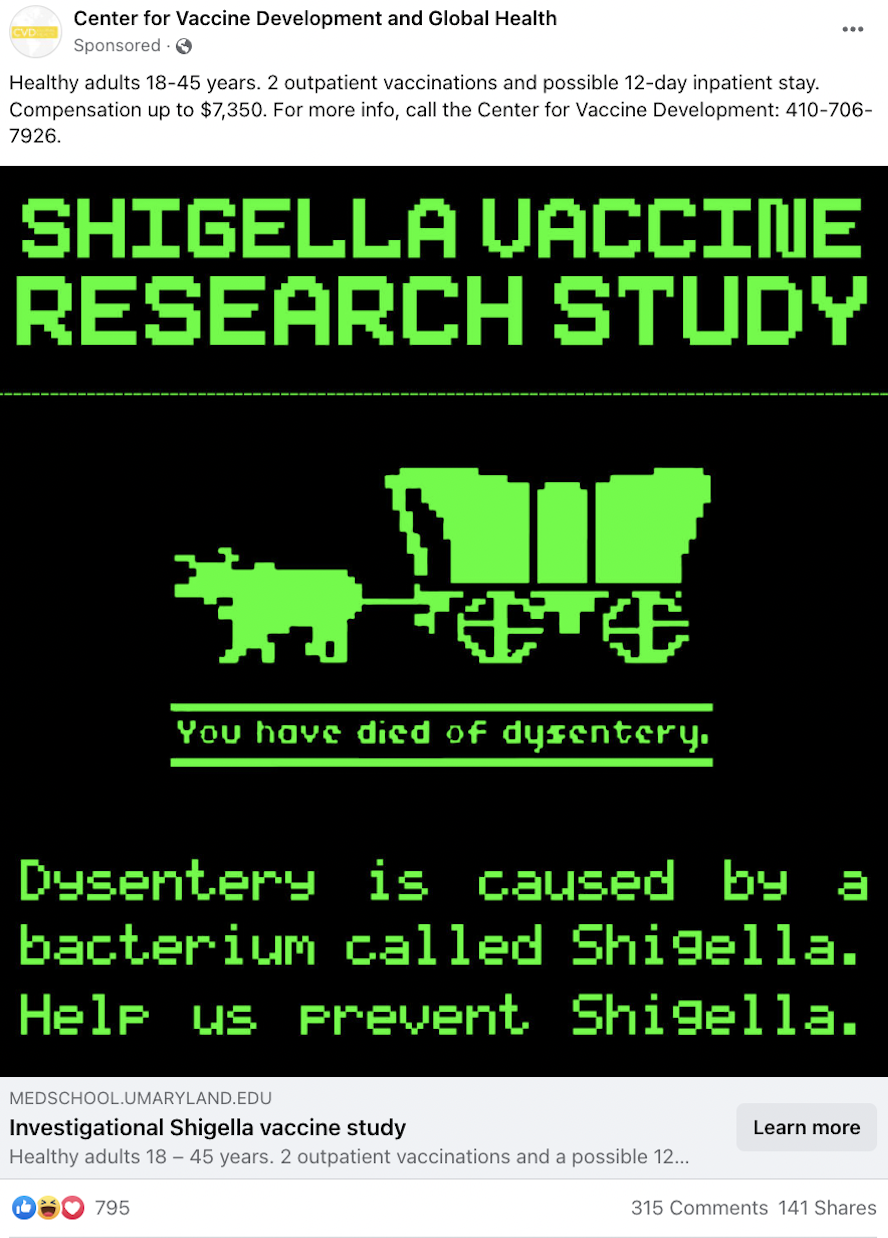
The study’s very clever Oregon Trail-themed ad that both Mallory and I initially clicked on.
Shigella can be eradicated with antibiotics, but those aren’t always available, especially in the world’s poorest regions. Because it can be treated, though, and poses minimal risks to otherwise healthy volunteers, it’s a perfect candidate for human challenge studies. Shigella challenge studies help select the best vaccines to move forward to large scale field studies, which are very complex and expensive operations to run.
This interview has been edited and condensed for clarity.
Jake: So how did it go for you? What was the experience like?
Mallory: I felt like I had some kind of sneaky secret going in because I had seen all of your experience. I felt like the first couple days were super chill, learning and getting to know the nurses — we probably had like 20 nurses the entire time, which was weird — and getting to know the processes.
The actual day [of challenge] was fine. We split into two groups, and I was in the first. People were nervous about the taste [of the challenge solution] but I thought it was fine. I was a little bit nervous, but after I had done it — by the afternoon I had already forgotten about it. I’d be like, “Oh, yeah, I’ve been infected. I have be more careful about things now.” I feel like I was really prepared just knowing from your experience and what you’d already gone through. I felt fine and knew what to expect.
Tell us a little bit more about why you signed up. You saw my tweets, obviously, but what was going through your head — compensation, altruism, “I’m bored”, even.
It was a combo of all of those. I saw the ad on Instagram and submitted my email and then literally the next day my husband saw the post on Reddit of one of the articles someone wrote about you and said, “Look! I think it’s the same study!” And it was!
The money obviously stood out because they did advertise the amount. It made me think “Oh, this would be something cool to do for science and to help people.” Reading more about shigellosis and dysentery — you always hear about it and how it can kill you, but then to see about who it’s actually affecting is just so sad. To be able to help poor children that can’t speak up, and even people who aren’t getting antibiotics was nice.
And also, being able to shake up my summer was nice — I hate summer. The humidity when I left [the facility] just hit me so hard.
So were you nervous going in? Well, obviously the answer is yes, because there’s no way you’d be completely at ease — but how were you feeling when you walked in the doors?
I was a little nervous. My husband dropped me off, and what was funny was there was someone else right there coming in, so I instantly met someone. But he tested positive for Covid, so he left within 2 hours. Three people in total left for us. One guy decided after listening to [the head nurse’s] spiel about the processes and what to expect just decided he didn’t want to do it and left. One girl on challenge day had a class during the challenge. And she was like “well, I can’t skip this class” — so she just left. Which I thought was so bizarre, she’d already been there for two days!
So I was a little nervous, but meeting someone instantly going in, and recognizing all the CVD nurses was comforting, it was all familiar faces. I think I was the most nervous about where my bed was going to be. I was in the far-end dorm, in the corner by the window. … I did bring earplugs, and that was a lifesaver.
So what did the progression of your sickness look like?
I took the challenge Wednesday morning, and Friday night was when it hit me. I had the chills and I started sweating. Friday afternoon is when I got really bad joint aches. My hips and tailbone hurt so bad, and those beds are not comfy.
I would say like Saturday night I really wanted to be on antibiotics and my fever was not high enough — it’d be like 102.7 or something, so Dr. Chen said no, and I was like, I am so mad at you, I’m gonna punch you (laughs).
Then over a 12-hour period I had over 3L of stool — so he was like yeah, okay, you can start antibiotics. So Sunday morning I started them. I had two days of feeling really crummy, but by Sunday night I was feeling much better.
Any part of the process that was particularly surprising to you?
I was surprised how often we were getting our vitals taken — it’s what my entire day was structured around. When I got back home, I was waking up at 7am!
Also constantly having to collect a sample whenever you used the restroom. But then by the time you were done it felt weird not to — I was amazed how quickly everyone fell into the routine and how it did not feel at all awkward to be talking about your bowel movements with complete strangers, people you didnt even know existed a week ago!
I liked that, though, because it felt like everyone got along super well even though none of us had anything in common — it was a really eclectic group of people. I wouldn’t say anyone in there is now like my best friend for life, but there’s a few where we follow each other on Twitter now, and I’d be interested to know how they’re doing, and I’d say hi to at the store.
Oh also, the food was really good. I was not expecting that. It was funny, though, They took away all of our Gatorade once — the Gatorade we had was fruit punch, and they realized that what they thought was maybe dysentery in the stool was actually the red Gatorade. So they took that away and only later replaced it with the clear and blue ones.